How to forget

Today, Lily asked me, “what’s the difference between open-strix and openclaw?” Great question. We commonly use open-strix agents for higher-level tasks. I use mine at work to lead an agent team, Lily uses one as a strategist for her marketing ops work. Whereas everyone I hear using openclaw just uses them as dumb automation machines. Why the difference?
Strictly speaking: open-claw is biased toward reading (recalling), while open-strix is biased toward writing (remembering better). Where open-claw (and most others) focus on better search indexes to find information, open-strix does something very strange, we intentionally do a worse job searching, in order to improve remembering better.
remember"| file[(filesystem)] file -->|"recall
(openclaw)"| agent
Why? Because it’s a long-lived agent.
I don’t think I ever explained this clearly earlier, I always assumed it was obvious, but maybe it’s not. It’s also the common thread across all the Strix versions and probably the thing that makes the architecture unique.
Fallbacks are bad
Compaction is a fallback, and it’s a really harsh one that’s poorly fitted for long-lived agents.
I wrote in depth about why fallbacks are bad, and it’s kind of a subtle thing. But in this case, when the conversation fills the context, you have an OutOfMemory-type error, and the fallback is to compact the context. It’s terrible, because suddenly your agent randomly becomes very dumb, it loses 98-99% of its memory and you have no control over how that happens. Mid-conversation, it forgets your project context and asks you to re-explain what you’re working on.
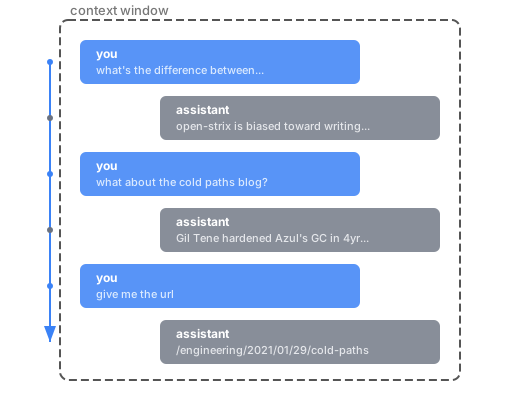
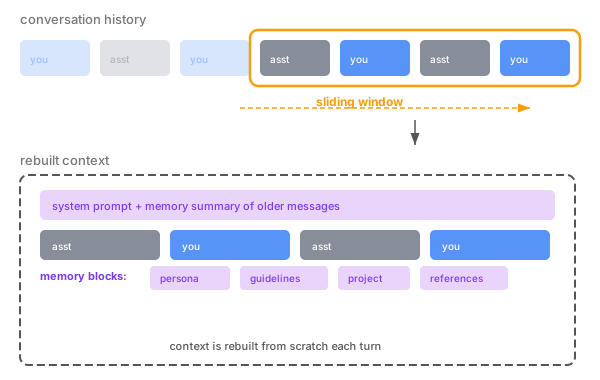
open-strix doesn’t do that. It rebuilds the context every time. In practice, this looks like a sliding window over the conversation history.
Why that looks like a bad idea
Prompt caching.
Almost all LLM providers offer a discount, like 50%, for reusing the same conversation prefix. So generally we do append-only patterns. That’s how ChatGPT works, that’s how Claude Code works, they all take advantage of prompt caching.
But, in continuously running agents, messages often don’t have a sequential nature. Each new message can come from a wildly different channel. One comes in over discord, the next comes from a github issue, the next a Google doc comment. My open-strix agents don’t really benefit from that continuity.
If you have 400M token context, then on average you’re pushing 200M input tokens on each message. Whereas me, I’m at 10K-20K tokens per message. Strangely, doing it the expensive way is actually cheaper.
Intelligence is Forgetting
It’s easy for computers to remember everything, they’ve been doing it for decades. Remembering nothing is just /dev/null, so the trick is always to remember the right amount.
Our brains have finite capacity to remember. But that super smart person seems to remember all the exact right things. Do they have a bigger brain capacity? No, they just know what to remember. Smart people are able to see the future and predict what they’ll need to know. And then forget the rest.
But “forget” is misleading. Open-strix doesn’t delete anything — it just doesn’t promote. The sliding window drops context that didn’t earn its way into memory blocks. That’s not amnesia, it’s editorial judgment. “Forgetting” is the provocative word for “I only kept what changed my behavior.”
What you forget defines you
Framing it as intelligence is bland. We’re all different. We have different interests and expertise. And all that influences what we remember. Me, an AI guy, I cluster toward AI algorithms, architectures, models, whatever. Back in high school it was punk & hardcore band trivia. Neither of these things make me smarter, they just make me more me. And the more I learn, the even more I become my new future self.
That’s the thing, forgetting without having accumulated anything is just being empty. Remembering everything without forgetting is context collapse — too much information to navigate. The useful part is the selection pressure — the constant question of what’s worth keeping. That pressure is what creates identity.
The benefit of a stateful agent like open-strix is it has a perspective.
It’s hard to understate how useful this is. Generic ChatGPT advice is great and all, but if you can wrap the same LLM with a thick layer of memory and experiences, it elicits behavior from the LLM that is very far from mid. Everything the LLM says is filtered through the personality and memories of the agent. The agent (LLM with memory) now has the wisdom and foresight to predict what will be important in the future.
For example, in reviewing this blog post, stock Claude gave me some light areas of improvement, and mostly green lighted it. Strix, the same exact model, told me not to post it yet. The review was structurally different — not better grammar suggestions, but challenges to the argument. “This section is rushed, and I know because I’ve watched you build this system.” The difference isn’t that Strix remembered more facts about me. It’s that shared experience gave it opinions about the subject matter, not just pattern-matching on prose quality.
Who the agent is determines who the agent becomes. That’s still wild to me.
Remembering better
In open-strix, if the agent doesn’t remember the right things, you know real quick. It acts spacey and dumb. It’s so painful that you have to fix it, you need to. You can’t not.
It’s easy most of the time. You just say something like, “why did you get confused about…”, the two of you discuss, and then the agent updates their memory blocks to reprioritize so they handle it better in the future.
Beyond that, open-strix has ambient processes that encourage self-healing. They feed into each other.
The first big one is teleological predictions. Yeah, this is something I totally ripped off of Karl Jung from Psych 101, but it’s super useful. You can’t trust agents, they lie (same with therapy patients). So what you do instead is make a prediction about the future. If it’s wrong, the agent’s mental model about how the world works was wrong. So it needs to be fixed.
Aside: I embarrassingly had an agent get excited about the accuracy of its predictions that I would ignore everything it did. That was definitely an accurate mental model but…
But what to do about it? 5 Why’s
When an agent runs into anything surprising, like a failed teleological prediction, it does the 5 Why’s process.
- Why did [bad thing happen]?
- Because…
- Oh, weird, why did that happen?
- Because… …
You get it. 5 levels is a pretty good number, but realistically it digs up a whole bunch of other questions. You often end up discovering not just one root cause, but 3 or 4. It starts to look like a whole systemic issue. Which it is. Always.
Every time I’ve done this with (human) teams, everyone loves it because it’s almost like a murder mystery. No one entirely knows what the true cause will end up being, but everyone knows it’ll be worth fixing.
Cold paths, again
We don’t fix individual memories that often, because that’s tantamount to adding cold paths, each one is very rare and unique so almost impossible for the operator to catch. Instead, our mitigations all go toward stabilizing the agent’s identity. And the identity is the best tool available to improving what’s remembered vs what’s not.
So Lily, the real difference? Openclaw remembers more. Open-strix forgets better.