Knowledge Graphs

Not gonna lie, I hate knowledge graphs. Not long ago, this post would have been about why they’re terrible (and they are, there’s truth in this). But I’ve come to realize that there’s some very good reasons to use knowledge graphs in AI. I’ll walk you through my arc, maybe you can appreciate them too.
What’s a KG?
A knowledge graph (KG) is a special type of graph database where the nodes are entities (nouns) and the edges are relationships. Typically both the entities & relationships also can have properties.
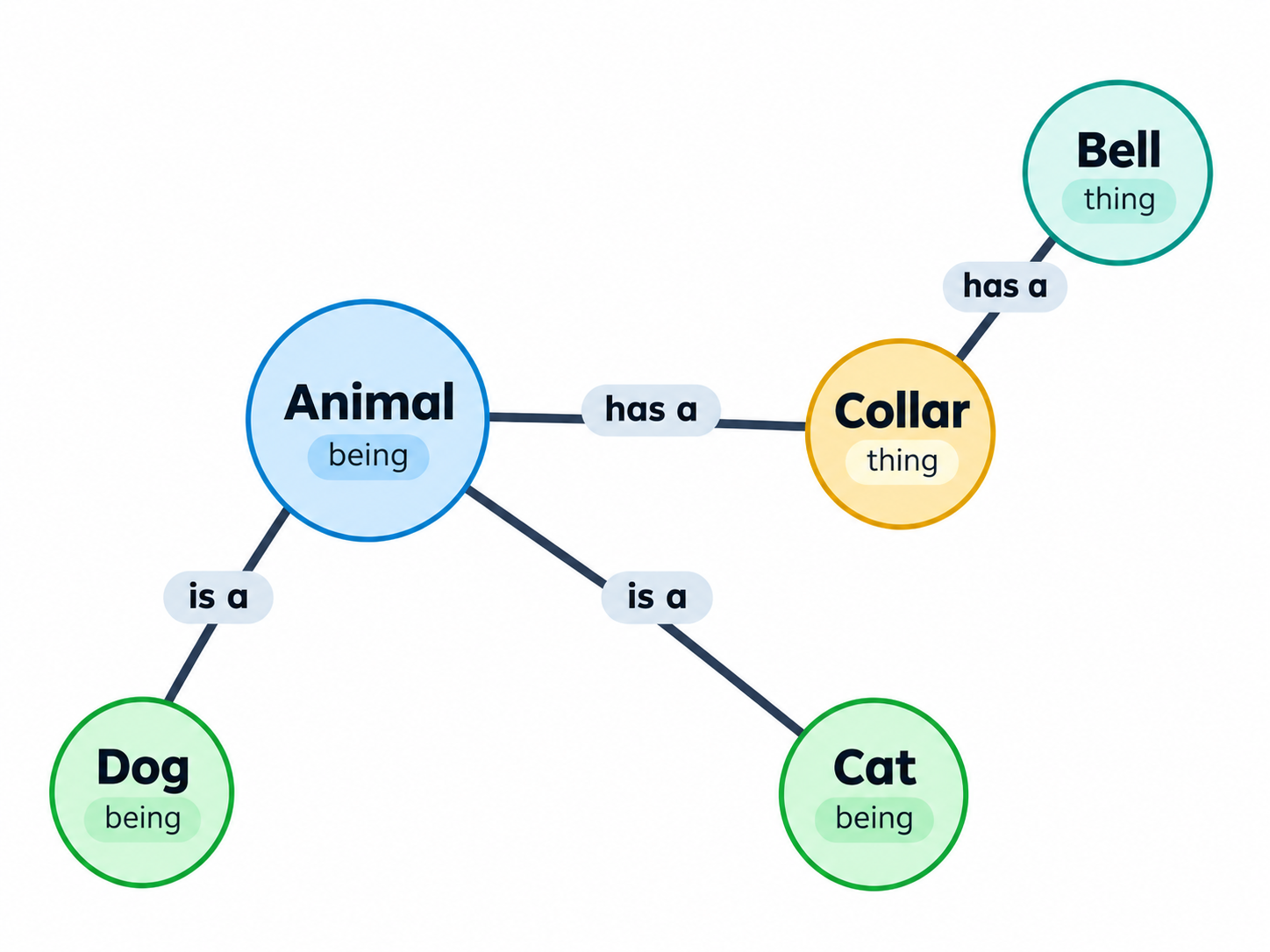
Narrator: Yo, it’s not necessary to legit use a graph DB engine, SQL works fine for almost anyone.
The promise of KGs was that they can express logic that you can do proofs on, or infer results that might not have been obvious at first. It’s a rich, flexible data model around potentially gnarly domains. Also, you can use them to ground LLMs.
Why don’t I like them?
They’re not bitter lesson pilled.
The Bitter Lesson was an essay to AI researchers stating that the methods that work best in AI are those that get better as compute improves.
I’ve commonly conflated the Bitter Lesson with agents — if you’re building an agent and a new model drops that’s 2x as good, does your agent also get 2x as good? If not, then your design isn’t Bitter Lesson pilled and you’ll fall behind quickly. It follows the same logic as the Bitter Lesson, but technically incorrect.
Models are getting better regardless if you want them to, no effort on your part. Like a force of nature. So effort is better spent on multiplying LLM gains (that will happen anyway) rather than trying to big-brain the smartest solution.
Knowledge graphs are notoriously difficult to construct. They frequently take PhD-level experts and lots of design to get the KG schema (ontology) constructed well. The Bitter Lesson directly warns against methods that require investing in complex designs (yes, knowledge graphs).
Brittleness
You can tell you’re dealing with a system that’s not Bitter Lesson pilled when you bump into incorrect assumptions about the real world. Things don’t feel right, broken.
The problem with knowledge graphs is they’re inherently limited to what a single human can conceive, and usually
far more limited than that. Like with code. Code that has a lot of if statements and edge cases gets super
complex real fast. Same with knowledge graphs for a really similar reason, you’re effectively hand-coding the
domain, so it all has to fit into someone’s head.
And so they’re lossy. Read any good book on designing ontologies or knowledge graphs and this is the first thing — they convince you to accept that it can’t be perfect, so just focus on the highest value things.
Which is where the problems stem from. The “highest value thing” is what someone somewhere (more likely, a committee of people) thought was the most valuable, and frequently misses a thing you thought was important.
But they’re good
Alas, I do like knowledge graphs! They’re really good when you need systematic repeatable completeness.
For example, ARTEX (not giving you a direct link because it’s an offensive cybersecurity tool, but here is an example of it being used). It uses two graphs (technically not knowledge graphs). One graph keeps track of assets like IP addresses, apps, services, ports, etc. The other graph is for exploration and stores things like goals, findings, observations, etc.
ARTEX is basically a very Claude Code like tool that uses these graphs to fan out and completely saturate every asset with every possible vulnerability in effort to find a way in.
I’ve started using a KG-like graph for tracking AI news & developments. It’s got:
- Entity types: Person, Organization, Model, Software, Hardware, Research Artifact, Policy, Place, Concept, Security Incident, Security Issue, Mitigation
- Relationship types: has metric, compared with, released, developed by, criticisizes, questions, affects, comments about, predicts, mitigated by, announces, reports, advocates, recommends, uses method, proposes, supports, assesses, has price, has failure, restricts
One of the core principles with this project is that it doesn’t store facts, it just stores observations. The factuality is determined at query time.
The most exciting thing that happened with this was that I told an agent to “let me know if anything surprising happens”, where “surprising” is defined as anything that conflicts with the conventional knowledge of the graph. It proceeded to spend the next 12 hours giving me updates on truly surprising things that I wouldn’t have otherwise caught.
This stuff is easy with graphs.
In the past I’ve tried to get agents to do this with just plain-text storage and it’s just really hard. To do it well, you have to add so much prompting to describe what “surprising” looks like that you’ve effectively designed a KG ontology. So even though it’s just relying on LLMs, it doesn’t feel any more Bitter Lesson pilled.
Where KGs work best
Current LLMs seem to do poorly with systematically listing ideas or processing edge cases & states.
If you want it to check for “all the bad things”, they do a whole lot better if you give them a list of all the things you consider bad. At least it gives you a lot more consistent behavior. It’s possible, just not great.
KGs work best when they’re filling in for the weaknesses of LLMs. If you only store prose journal entries, they’ll inconsistently find observations of a certain type. Part of the problem is every time you have to re-evaluate the list, the LLM has to completely re-discover the observations. And that re-discovery introduces fluctuations in behavior.
Will this change?
I’m not sure. It’s hard to predict where AI is going to go next.
One thing on my mind is that KGs can be processed via code. And code is hella cheaper and faster than any LLM interaction will ever be.
I have a theory that the general public, in the long run, may rarely interact directly with AI. Instead, they’ll interact with code that’s written, maintained, and operated by AI agents. They still get that dynamic feel, because the code quickly adapts to what they need. But it’s fundamentally just code. KGs are analogous to data-level code, and so they’re a great tool for AI to inject it’s own intelligence into plain code.
I have no idea if that’s a realistic future, but there’s good reasons to think it might be. It’s certainly cheap and a whole lot more scalable.
When predicting which technology or technique wins out, a lot of times it’s actually social factors that determine fate. And in this case, those social factors could just be that KGs are cheap and scalable. And using AI to maintain the KG would convey most of the dynamism benefits.
Conclusion
Well anyway, do what you want. Be cautious with knowledge graphs. Be bitter lesson pilled. But also be aware of LLM weaknesses. They could be a good solution!