Bluesky Thread

HRM: Hierarchical Reasoning Model

View original thread
HRM: Hierarchical Reasoning Model

ngl this sounds like bullshit but i don’t think it is

- 27M (million parameters)
- 1000 training examples
- beats o3-mini on ARC-AGI

arxiv.org/abs/2506.21734
arxiv.org
Hierarchical Reasoning Model
Reasoning, the process of devising and executing complex goal-oriented action sequences, remains a critical challenge in AI. Current large language models (LLMs) primarily employ Chain-of-Thought (CoT...
67 16
here’s a good take, comparing HRM to quaternion process theory from neuroscience

it models cognition through 2 dimensions

1. fluency vs empathy
2. fast vs slow

medium.com/intuitionmac...
medium.com
The Hierarchical Reasoning Model Through the Lens of Quaternion Process Theory: Thinking Fast and…
Introduction: Mapping Artificial Intelligence to Cognitive Quaternions
6
the problem as they see it: CoT reasoning isn’t compatible with the bitter lesson, it requires too much human involvement to get right
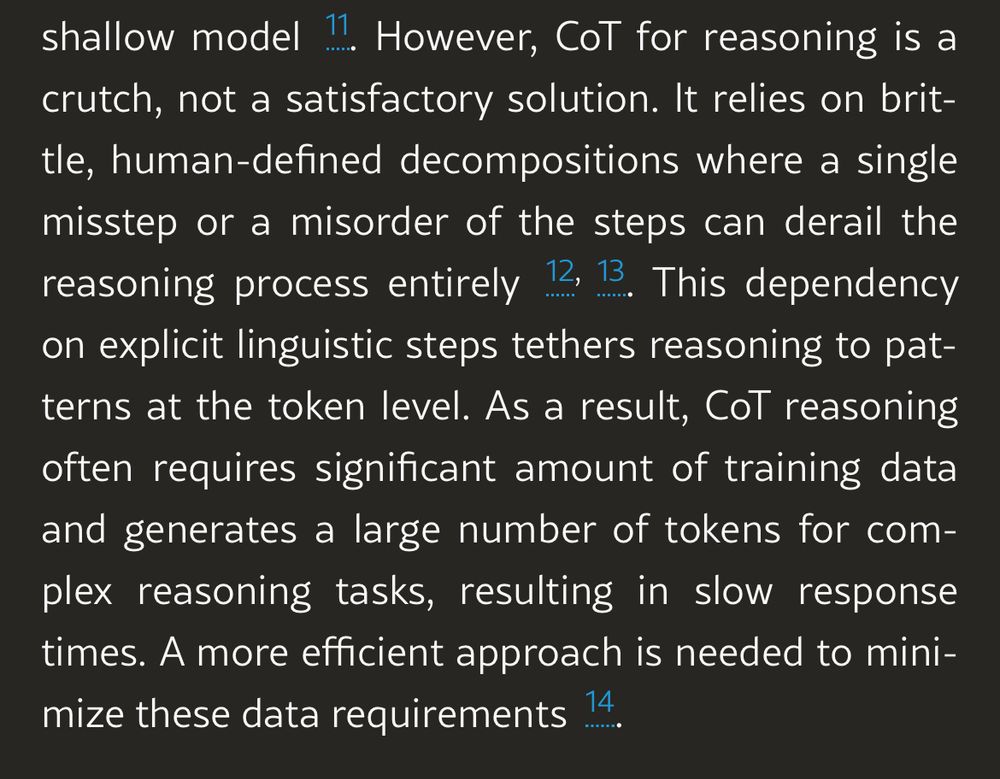
However, CoT for reasoning is a crutch, not a satisfactory solution. It relies on brit-tle, human-defined decompositions where a single misstep or a misorder of the steps can derail the reasoning process entirely 12, 13. This dependency on explicit linguistic steps tethers reasoning to patterns at the token level. As a result, CoT reasoning often requires significant amount of training data and generates a large number of tokens for complex reasoning tasks, resulting in slow response times. A more efficient approach is needed to minimize these data requirements 14
11
what’s notable about this paper is how often they refer back to biology

imo that’s a sign of a big breakthrough — combining domains and getting real results
The human brain provides a compelling blueprint for achieving the effective computational depth that contemporary artificial models lack. It organizes computation hierarchically across cortical regions operating at different timescales, enabling deep, multi-stage reasoning 20, 21, 22. Recurrent feedback loops iteratively refine internal represen-tations, allowing slow, higher-level areas to guide, and fast, lower-level circuits to execute-subordi-nate processing while preserving global coher-
23
ence
24 25
Notably, the brain achieves such
depth without incurring the prohibitive credit-as-signment costs that typically hamper recurrent networks from backpropagation through time
19 26
**********••
9 1
HRM is four learnable modules

1. input network
2. recurrent low-level
3. recurrent high-level
4. output network

the low-level module executes several times for each high-level iteration (i.e. there’s more compute units/neurons in the high-level module)
10
i’d love to see more. the architecture definitely has limitations. but the model is *tiny* and appears to be quite adaptive
9

9 hours later
bsky.app/profile/timk...
Tim Kellogg @timkellogg.me
Opus made me this to explain it

it's a lot more complex than a simple RNN. Basically a "figure 8", where each loop is feeding into the other

* H-module grounds L-mod to keep it on track
* L-mod reports findings to H-module to plan next strategic step.
4
67 likes 16 reposts

More like this

×