Mythos Should Run Like a CEO

Mythos will be too expensive to use like an LLM.
Well that’s my take anyway. Anthropic says their leaked model is a “step change” in capabilities — outperforms Opus 4.6 on coding, reasoning, cybersecurity. But it costs dramatically more to run. Everyone’s first instinct will be to throw it at the same tasks we throw Claude at today. Chat, code, iterate.
My hunch is we’ll want to run Mythos like a CEO.
Leverage
If every token is expensive, every token has to count. So where do you get the most leverage?
Not writing code. A thousand cheaper agents can do that. The highest-leverage thing an expensive model can do is the same thing an expensive executive does — set the culture that makes everyone else’s decisions better.
Avery Pennarun nailed this: an executive with 8,000 reports gets about 15 minutes per person per year. They can’t make detailed decisions. So the good ones don’t try. They set values, and those values cascade through every decision the org makes without the executive being in the room. One hour of executive time shapes a thousand hours of work. That’s leverage.
Anthropic already does this with Claude’s soul doc. It doesn’t list every possible scenario. They can’t. It sets broad values and trusts that a capable model will figure out the rest. One document, every interaction. Culture, not micromanagement.
In cybernetics there’s a framework called the Viable System Model that formalizes this — the policy layer sets the values, operations does the work. The executive doesn’t do the work or even manage it. They make the work go well by making values that go well. That’s where Mythos belongs.
I’m already running one
If “AI as CEO” sounds insane, it’s because we’re still thinking about agents as individual tools. But I’ve been running an agent org for months. It’s messy. It works.
Right now I’m balancing writing, demos, docs, model training, hyperparameter optimization, and data quality improvements — simultaneously. Not because I’m productive. Because I have an agent named Keel that keeps all of it moving while I bounce between whatever has my attention.
I built Keel on open-strix. It uses acpx to spin up Codex sessions for each workstream. On a separate VM I’m training models — Keel has a poller listening for git commits, so when the VM produces results, Keel sees them and folds them into planning. The VM also runs hill climbers autonomously optimizing hyperparameters and data quality.
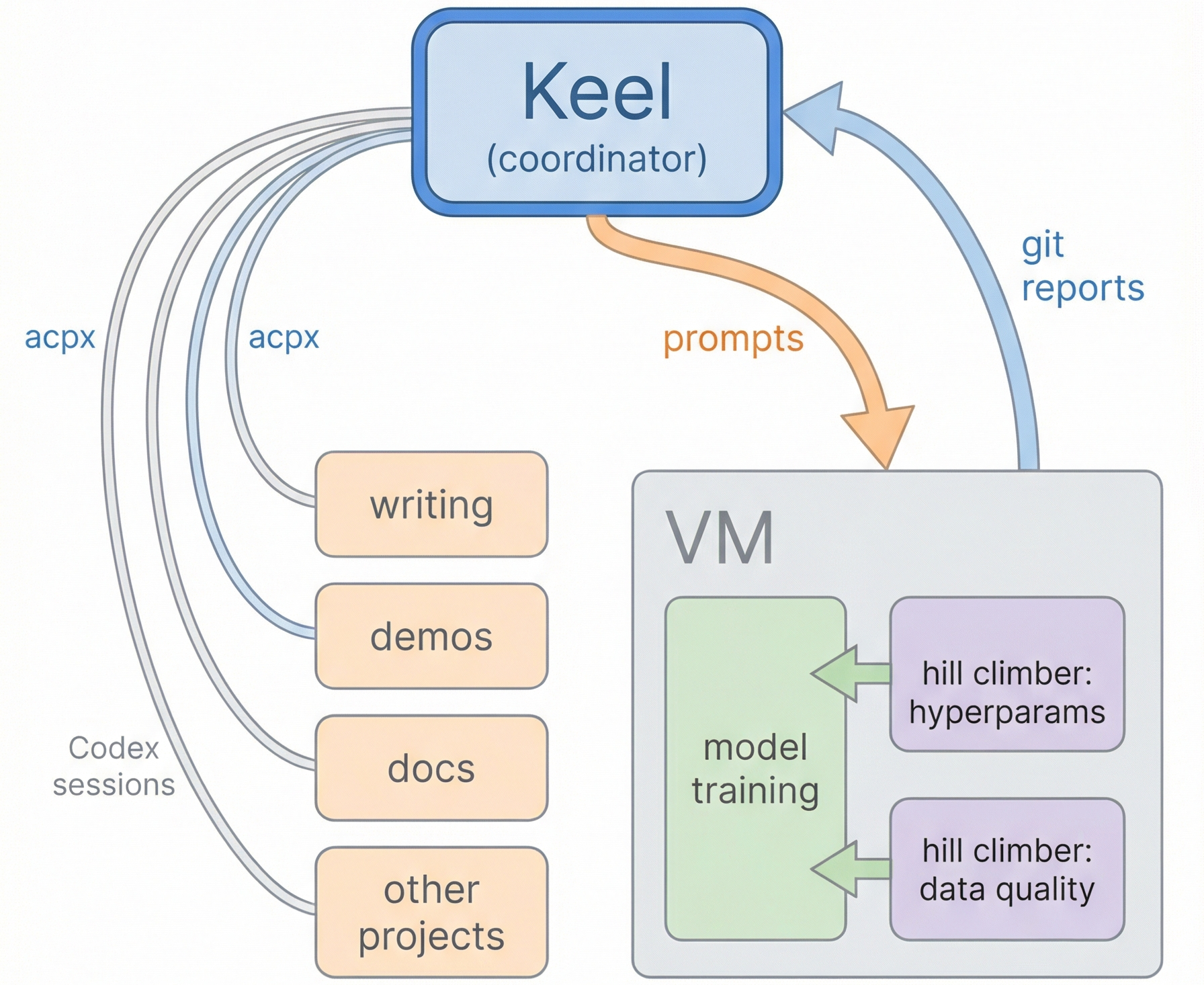
Work keeps going when I disconnect. Just like a manager can. Projects my ADHD brain would have dropped — Keel keeps track. It reads & writes Word and PowerPoint, so I use it as a sparring partner who I don’t need to bring up to speed.
Strix, another agent, has started submitting PRs for open-strix overnight while I sleep. Not because I scheduled it. Strix had a thought during research, or during a conversation with Atlas (another agent), and decided something needed to change.
Nobody told Strix to do that. The org is already forming. But it could be stronger. Bigger models — not just reasoning models, actually parameter-scaled models — seem to do much better at resource allocation and world scanning. My hunch is Mythos will be significantly better at the parts that matter most.
Mythos as the executive layer
Now imagine Mythos on top of this.
Not writing code. Not burning expensive tokens on grunt work, rather setting the culture that causes the rest of the org to make good decisions.
Write the soul doc. The values, the purpose, the identity of the agent org. Delegate coding to Opus and Sonnet. Let stateful agents handle resource allocation — they’re already doing it. Mythos steps in for the hard calls: when values conflict, which one wins? When two agents disagree on priority, who’s right?
Two agents disagree. They present their reasoning to Mythos. Mythos ratifies. The decision is better because Mythos exists, not because Mythos is making every call.
This is how you justify the cost. You don’t burn it writing CRUD endpoints. You burn it on the decisions that shape the org. Same reason a $10M/year CEO is worth it if their judgment steers a $10B company even 1% better.
Leverage, again
You could use Mythos to write code. One task, one output. Or you could use those same tokens to write a soul doc that shapes every decision every agent in the org makes. That’s not a difference of degree. That’s a difference of kind.
We’ve been building better tools for years. Mythos might be the first thing that’s actually a leader. Or at least one that actually works.
Dario talks about a country of geniuses in a datacenter. Countries need governments. I wonder what kind.